Turkey, Iran, Central Asian states, and others may align with Pakistan as a regional leader after India’s strategic humiliation.
By M Qadeer
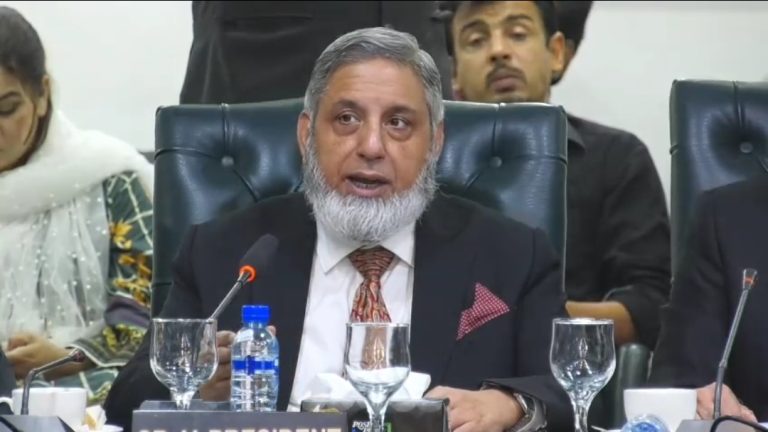
LAHORE – In a strong-worded and forward-looking statement, Lahore Chamber of Commerce and Industry (LCCI) President Mian Abuzar Shahd has predicted a massive shift in global and regional power dynamics following Pakistan’s recent thumping military victory against India, with the help of cutting-edge Chinese technology.

According to Shahd, the successful destruction of numerous Indian posts, arms depots, and launching pads—from where innocent Pakistani citizens were frequently targeted—marks the turning of the tide in South Asia. The icing on the cake, he pointed out, was the reported downing of India’s Rafale jets, built with France’s state-of-the-art technology. These events, Shahd says, spell the rise of China as the next global superpower, with Pakistan positioned as an integral part of this new order.
Shahd believes this dramatic military moment will shake things up in the region. “Iran, Turkey, the Central Asian States, Russia, and even Afghanistan are expected to gradually join hands in this emerging alliance,” he said. “India’s bullying tactics have worn thin, and many countries that were snubbed or sidelined by New Delhi are now looking toward Pakistan as the patron-in-chief of a new regional bloc.”
He emphasized that Pakistan’s defense is now foolproof, and having shown the world its capabilities, the time has come to shift gears and put the economy in the driving seat.
“Defence is sorted — now it’s time to sort the economy,” said Shahd. He proposed the immediate imposition of a 1 percent war tax to begin paying off foreign debts, including those owed to the IMF and other international agencies. “We can’t keep going round in circles. If we are serious about becoming a key player in the new world order, we have to clean up our own house first,” he added.
According to Shahd, Pakistan’s business and industrial sectors must now be placed front and center of national policymaking. “We’ve shown the world what we can do with jets and missiles. Now let’s show them what we can do with trade, exports, and innovation,” he said.
In what may be seen as a bold and controversial proposal, Shahd advocated for opening trade with India—not out of weakness, but from a position of strength. “We’ve made our point militarily. Now, with clear-headed diplomacy, we should explore economic cooperation. Trade is not about surrender; it’s about playing smart,” he said.
He stressed that regional trade integration would benefit not only Pakistan but also its neighbors, bringing stability, jobs, and growth. “Look, we’ve already carried the burden of defending our borders. Now is the time to cash in on peace,” he added.
Following India’s military setback, Shahd believes many smaller regional countries are now rethinking their alliances. “For years, they were either ignored by India or bullied into silence. Now they see Pakistan standing tall and may look up to us for guidance and partnership,” he said.
He urged Pakistan to seize the moment, using both soft and hard power to establish itself as a regional leader, especially in economic connectivity, trade routes, and energy corridors. “The China-Pakistan Economic Corridor (CPEC) is already a golden opportunity. Add to that ties with Turkey, Iran, Russia, and Central Asia — and we’re looking at a whole new ball game,” Shahd noted.
Summing up, the LCCI chief said that Pakistan has turned a corner, and now the country must take the bull by the horns and pursue economic self-reliance. He stressed the need for:
• Immediate introduction of a 1% war tax to reduce debt.
• Strengthening trade and investment ties with China, Central Asia, and the Middle East.
• Opening trade talks with India and other regional players from a position of power.
• Providing full support to local industries and SMEs.
• Leveraging regional goodwill to build a trade-driven foreign policy.
Shahd concluded: “We’ve shown courage on the battlefield, and now we must show wisdom in the boardroom. The world is watching, and the ball is in our court. Let’s not miss this golden opportunity to rise — not just as a military power, but as an economic powerhouse in the region.”
About the Author