By Asim Shahzad
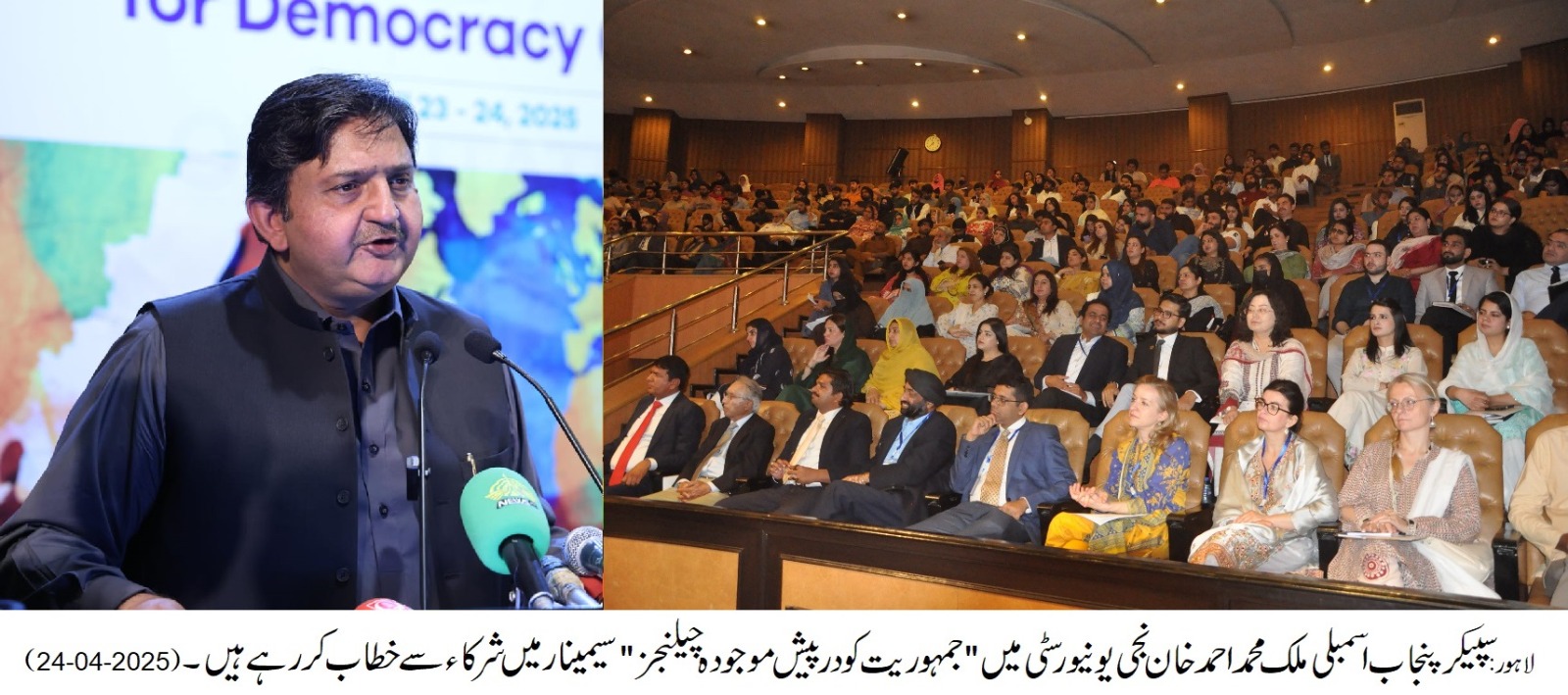
LAHORE – Speaker Punjab Assembly Malik Muhammad Ahmad Khan emphasized that the true foundation of democracy lies in the power of the people’s vote, which becomes meaningful only when citizens are provided with fundamental facilities such as health, education, employment, and justice.

Addressing the International Democracy Conference at a private university in Lahore, he urged policymakers to propose practical solutions for national progress based on ground realities and to strengthen state institutions through effective strategies.
He highlighted that national development is not the sole responsibility of governments but a shared obligation of every individual, institution, and sector of society. Speaker Khan called on all segments of the nation to recognize their roles and contribute to building a stronger democratic framework.
He further stressed the importance of responsible use of social media, suggesting it should be a platform for promoting the national narrative, increasing awareness, and encouraging positive thinking and behavior. He noted that a mature society is built through awareness and responsible civic engagement.
Later, speaking to the media, Speaker Khan reiterated Pakistan’s strong commitment to national security and independence. “Pakistan is a nuclear power, and its Armed Forces are a source of national pride due to their professionalism and history of sacrifice,” he said. He made it clear that any laxity in matters of national protection will not be tolerated.
Commenting on India’s recent allegations of terrorism, he dismissed them as baseless and detrimental to regional peace. “Pakistan has consistently adopted a responsible approach, and these accusations are a tactic to undermine our positive global image,” he stated.
Referring to the tragic Jaffer Express incident, he underlined Pakistan’s unwavering sacrifices in the war against terrorism, stating that the nation’s commitment and strategies remain exemplary.
The conference was attended by teachers, students, civil society members, and media professionals from various universities, where discussions focused on democracy, good governance, social media’s impact, and the importance of safeguarding human rights.
About the Author