By Asim Shehzad
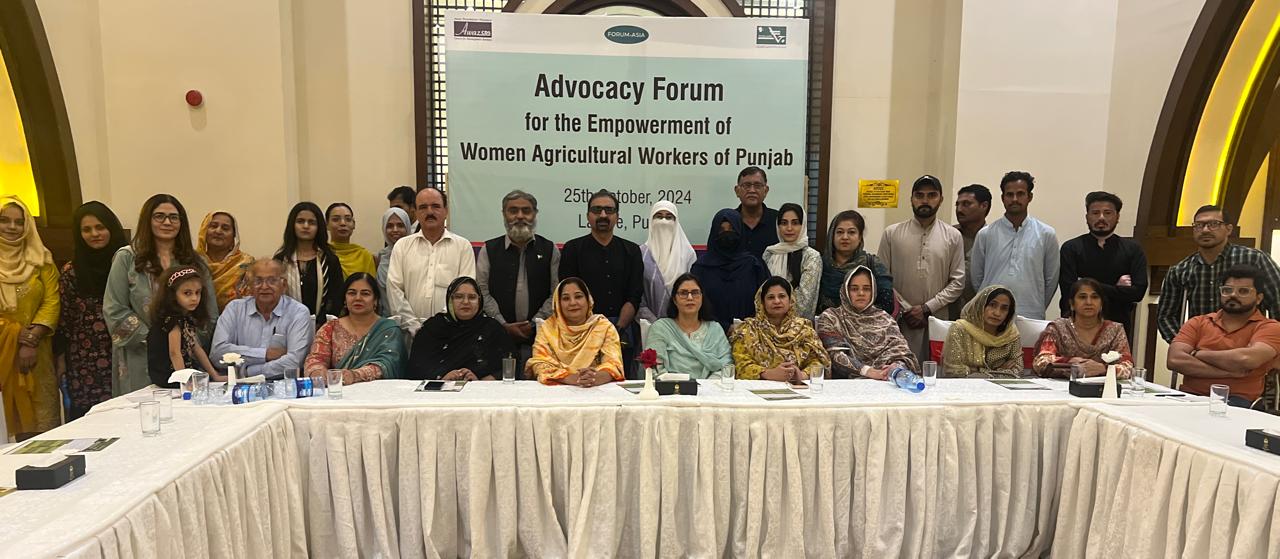
LAHORE: AwazCDS-Pakistan hosted an influential Advocacy Forum for the Empowerment of Women Agricultural Workers at the Faletti’s Hotel in Lahore on October 25.

The event gathered a diverse group of stakeholders, including government representatives, media professionals, academics, youth advocates, and labor leaders. This significant gathering aimed to address key challenges faced by women agricultural workers, with a strong focus on the Punjab Labor Code 2024 and necessary legislative advancements for equitable labor practices.
Mr. Zia ur Rehman, Chief Executive of AwazCDS-Pakistan, provided a comprehensive overview of the Punjab Labor Code 2024, focusing particularly on Chapter 4.2, which pertains to agricultural workers. His detailed brief highlighted critical areas where the labor code could better support agricultural workers’ rights, especially regarding fair compensation, the enforcement of written agreements, and the right to collective bargaining. Emphasizing gender equity, he underscored the importance of safeguarding the individual rights of female agricultural workers.
Mr. Rehman brought specific attention to Section 218 of the code, which outlines agricultural workers’ rights to fair compensation and secure agreements. He advocated for prioritizing cash payments over payments in kind, which he noted could often be a means of exploitation. He also stressed that each family member working in agriculture, particularly vulnerable women, should receive individual compensation. Additionally, Mr. Rehman urged for mandatory written agreements to protect informal sector workers, suggesting clearer language within the code to prevent potential loopholes. In light of pending rule developments, he proposed a defined timeline for the creation of these guidelines, aimed at securing workers’ rights more effectively.
Representing the labor community, Mr. Niaz Ahmed, a prominent union leader from the textile industry, raised concerns about the Punjab Labor Code 2024. He criticized the code’s global agenda, citing its implementation across various countries, including Pakistan. “Bangladesh’s workers’ unions have already approached international courts to contest this code, which prioritizes employer benefits over labor rights,” Mr. Ahmed noted. He also highlighted how the code could potentially end critical social protection schemes, posing a risk to workers’ well-being.
Adding to the discourse, Mr. Farooq Tariq, Secretary General of the Pakistan Kissan Rabta Committee, emphasized the committee’s commitment to advocating for women agricultural workers’ rights. He announced an upcoming campaign to push for targeted legislation that would ensure greater protections for these workers. He further advocated for agricultural fields to be officially recognized as workplaces, which would allow women workers to benefit from anti-harassment and social protection laws currently applicable to other workplaces.
The forum witnessed active participation from all attendees, who shared their perspectives, exchanged ideas, and expressed a unified commitment to strengthening protections for agricultural workers in Pakistan. The event underscored a growing consensus that the Punjab Labor Code 2024 must evolve to include the voices and rights of all workers, particularly those of women in the agricultural sector, as part of Pakistan’s broader pursuit of labor equity and empowerment.
About the Author